
Railway Brake Shoe Selection: Material, Mounting and Wheel Compatibility
Specify a tread brake shoe through its approved friction pairing, mounting definition and braking-system context rather than shape or material name alone.
· Braking · Ma'anshan Railwheel Industrial Technology Co., Ltd.
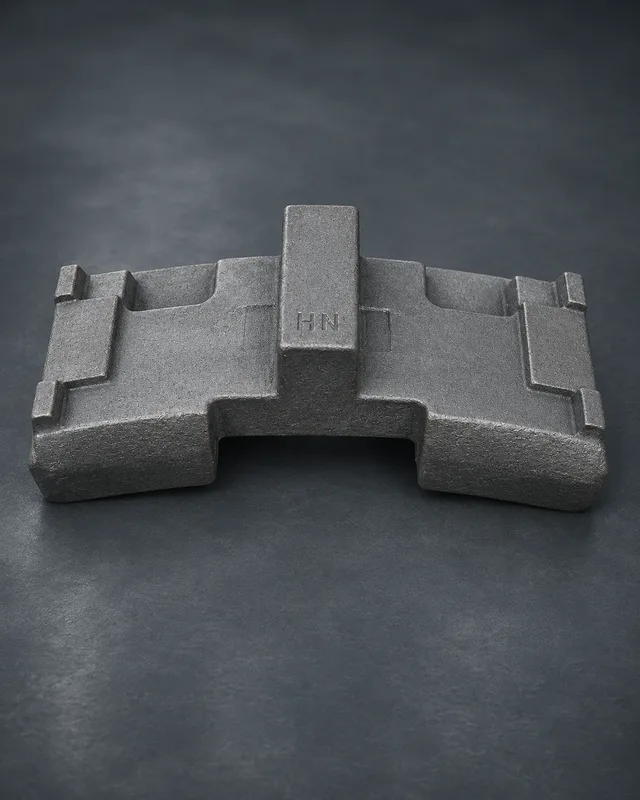
Select the friction pairing, not an isolated block
A tread brake shoe works against a railway wheel within a braking system. Its friction-material definition is therefore part of an approved pairing and vehicle application. Knorr-Bremse's public friction portfolio distinguishes pads and blocks and emphasizes application-specific pairings. Buyers should not interpret a generic material family or a similar external shape as evidence of equivalent braking behavior.
Separate material identification from appearance
A cast-looking or dark-colored block does not reveal its full material specification or approval basis. The RFQ needs the controlled friction-material designation and relevant part drawing. State whether the supply covers an identified replacement or an alternative that requires assessment. Do not select a product simply because a supplier describes it as high friction, low noise or long life without an agreed performance context.
Engineering principle: friction performance includes a thermal context
Braking converts vehicle motion into other forms of energy, including heat at the friction interfaces. The ideal translational kinetic-energy change, one-half of mass times the difference in squared speeds, illustrates why duty cannot be described by shoe dimensions alone. It is not a brake sizing formula: rotating inertia, resistance, gradient, system allocation and the actual duty require the approved analysis. Likewise, friction force and heat distribution cannot be assigned from a generic material label. The purchasing task is to preserve the approved pairing and evidence requirements rather than create new performance assumptions from a catalog description.
Verify the mounting and rigging interface
Identify the shoe or block holder arrangement, retaining features, backplate construction where applicable and the controlled contact profile. Parts that share nominal dimensions can differ at retention interfaces. Ask bidders to identify exceptions explicitly. The buyer should also provide the vehicle application and relevant braking-system references so the supplier understands the scope without assuming a universal fit.
Do not separate duty from acceptance
Service conditions such as the vehicle's braking arrangement and operating environment provide context for the approved requirement. They do not let a purchasing team invent its own friction or thermal acceptance values. Obtain the qualification and production evidence required for the actual specification. A laboratory result belongs to its tested material, configuration and method; it cannot be extended to every part using the same marketing label.
Keep replacement approval and receiving inspection distinct
Receiving checks verify the identity, condition and required evidence of the delivered item. They do not authorize a new material pairing. If the proposed brake shoe differs from the approved specification, resolve that difference through engineering before placing a production order. Preserve the accepted material and drawing references on the purchase order, packing list and supplier release documentation.
Application scenario
Illustrative scenario: a depot receives an attractive price for a shoe matching its holder dimensions, but the offered friction-material designation differs. Procurement records the commercial offer as conditional and seeks an authorized compatibility decision. A successful trial fit is not accepted as proof that the material is an approved replacement.
Technical review checklist
| Review item | Required definition | Purpose |
|---|---|---|
| Friction material | Controlled designation and evidence | Not inferred from color |
| Mounting | Holder and retention interfaces | Not just overall dimensions |
| Application | Approved vehicle and brake arrangement | Defines the pairing context |
| Approval | Declared deviations and disposition | Precedes production acceptance |
Frequently asked questions
Does matching the brake holder establish compatibility?
No. The friction material, wheel pairing and applicable vehicle approval requirements must also be satisfied.
Are a disc pad and a tread brake shoe equivalent products?
No. They act at different foundation-brake interfaces and require their own controlled definitions.
Technical references and scope
Public sources reviewed November 14, 2026 provide industry or standards-scope context. They do not transfer another manufacturer's approvals to Railwheel. Confirm the controlled standard edition, vehicle documents and acceptance criteria with the responsible authority. This article is procurement guidance, not installation, repair or service-release instructions.
Discuss your railway brake shoe requirement
Send the approved drawing and revision, application, quantity, required evidence and destination to Amy Sun at amy@railwheel.com. Scope and feasibility are confirmed through technical review before quotation.
 WhatsApp
 WeChat