
Railway Hose Routing: Turn Vehicle Movement into a Supplier Requirement
Translate mounting positions, relative movement and clearance constraints into a controlled hose inquiry without inventing universal bend limits.
· Braking · Ma'anshan Railwheel Industrial Technology Co., Ltd.
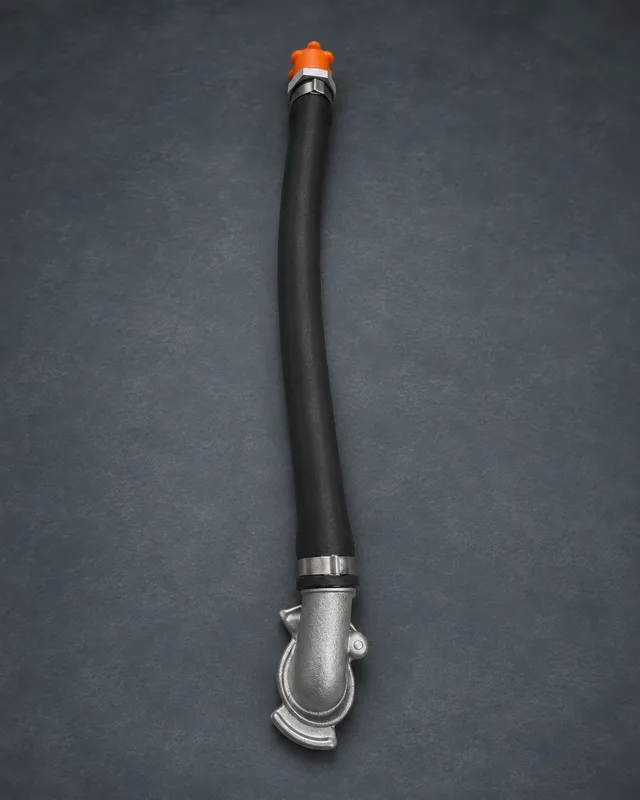
A static photograph misses the critical condition
The hose may connect components that move relative to one another. A routing arrangement that appears clear at rest can approach an obstruction or load its end fittings in another permitted vehicle condition. The responsible vehicle engineer must define the movement cases and acceptance requirements. The supplier needs those cases to assess its proposed assembly, not an instruction simply to make the hose longer.
Identify fixed points and controlled movements
Record the actual connection locations, fitting orientations, supports and the relevant relative movement. Distinguish an inter-vehicle connection from a bogie-to-body or equipment connection. These applications have different interfaces and specifications. State whether a support or restraint belongs in the supply scope. Missing support details can make otherwise identical assembly quotations technically non-comparable.
Engineering principle: motion creates a swept envelope
The installed hose occupies a succession of shapes over the approved relative movement of its endpoints and supports. Their combined occupied region is more informative than the centerline in the nominal condition. This does not mean every conceivable endpoint combination is physically possible; the vehicle definition must identify the required cases. The routing assessment then considers those cases against the surrounding geometry and hose-specific requirements. A nominal photograph contains only one state, so it cannot demonstrate clearance or acceptable end loading throughout the required envelope. Keep the vehicle and component verification responsibilities connected.
Use the assembly's own bending requirements
Minimum bend limits and installation allowances depend on the approved hose construction and application. Obtain the relevant manufacturer or controlled design requirements rather than borrowing a generic value. The review should consider clearance, tension, compression, twisting and contact through the defined conditions. This article does not provide a routing dimension or authorize an installation adjustment.
Treat abrasion protection as a design decision
If the design requires protection against contact or debris, identify its material, location, attachment and inspection requirements. An added sleeve can change local stiffness or hide inspection areas, so it should not be offered as an undocumented cure for an unresolved route. Confirm whether nearby heat, fluids, weather or cleaning agents affect the material specification and the approved maintenance assessment.
Record the verification boundary
Distinguish what can be checked on the loose assembly from what needs an installation fixture or actual vehicle. Length and end orientation may be component checks; the full movement envelope requires the approved installation definition. Specify responsibility for final installation verification and vehicle functional checks. A supplier report for the loose hose should not claim to certify an unseen route.
Application scenario
Illustrative scenario: a maintenance team asks for an extra-long replacement to avoid apparent tension. Before accepting the change, engineering evaluates the approved movement cases and discovers that added length could approach another component. The route and assembly definition are resolved together rather than treating length as an isolated purchasing adjustment.
Technical review checklist
| Review item | Required definition | Purpose |
|---|---|---|
| Connection points | Position and orientation references | Defines the installed baseline |
| Movement | Approved relative-motion cases | Exposes limiting conditions |
| Environment | Contact, fluids and temperature context | Supports material review |
| Verification | Component versus installation checks | Assigns the right responsibility |
Frequently asked questions
Is a longer hose always safer?
No. Additional length can introduce other routing problems. Any change requires review against the approved installation and motion envelope.
Can a loose-hose test validate the vehicle route?
No. The installed arrangement needs the verification specified by the vehicle's authorized process.
Technical references and scope
Public sources reviewed November 14, 2026 provide industry or standards-scope context. They do not transfer another manufacturer's approvals to Railwheel. Confirm the controlled standard edition, vehicle documents and acceptance criteria with the responsible authority. This article is procurement guidance, not installation, repair or service-release instructions.
Discuss your railway hose requirement
Send the approved drawing and revision, application, quantity, required evidence and destination to Amy Sun at amy@railwheel.com. Scope and feasibility are confirmed through technical review before quotation.
 WhatsApp
 WeChat