
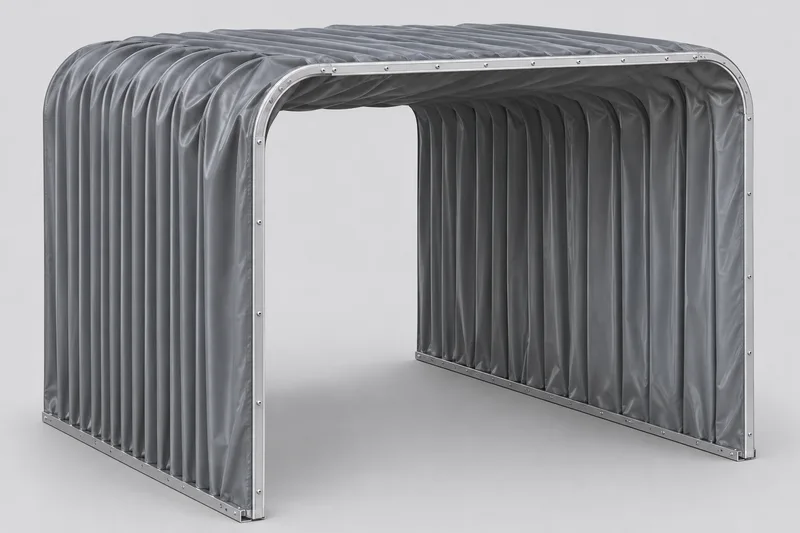
Separate the enclosure from the articulation system
Articulated bus bellows enclose the connection between vehicle sections. They are not automatically the articulation joint or the complete passenger passage system. Define whether the RFQ covers an outer enclosure, inner trim, mounting frames or a larger assembly. State who owns the structural and steering interfaces so a bellows-only quotation is not interpreted as approval of the complete vehicle connection.
Provide vehicle-specific mounting geometry
Send the body opening and attachment drawings for both boundaries, with a common reference condition and revision status. Include the frame contour, fastening arrangement and defined sealing interfaces. Overall width and height do not capture every mounting feature. For replacement work, identify any body repairs or previous modifications that may cause the observed vehicle to differ from its historical drawing.
Describe the approved movement combinations
The articulation definition should identify relevant translations and rotations at the bellows mounting boundaries. The responsible vehicle design determines the movement cases and their combinations. Material flexibility alone cannot establish clearance or endurance for another vehicle. Where the project includes inner panels or floor interfaces, check the complete passenger passage boundary rather than evaluating the outer folds in isolation.
Keep material evidence tied to construction
Record the required material construction, environmental exposure and applicable vehicle fire requirements through the project's approved specification. A report for one fabric does not necessarily cover a different laminate, seam or complete enclosure. Any proposed substitution should identify its evidence and deviations. Railwheel does not transfer another manufacturer's approvals or claim vehicle compatibility from an illustrative catalog image.
Plan replacement access and inspection
The buyer should identify the intended replacement boundary and the controlled maintenance documents required for installation. Confirm whether mounting frames and retained interior parts remain suitable through the authorized vehicle process. Inspection and acceptance criteria belong in the contract. Generic internet guidance must not replace the manufacturer's service limits or approve continued operation of damaged bellows.
Agree shipping and storage configuration
Packing should support the supplied frames and protect folds from unsuitable restraint or prolonged deformation. Obtain construction-specific handling and storage information rather than assuming every enclosure can be shipped tightly compressed. Identify loose fasteners and attachment parts in the package schedule. A receiving inspection should link delivered identity and condition to the accepted offer before the components enter the authorized maintenance workflow.
Technical RFQ checklist
| Supply boundary | Enclosure, frames, trim and explicit exclusions |
|---|---|
| Interfaces | Body opening, mounting contour and revision |
| Movement | Approved combined articulation cases |
| Evidence | Material, project inspection and delivery documents |
Frequently asked questions
Are bus bellows interchangeable with railway gangways?
No interchangeability should be assumed. Mounting geometry, motion, passage boundaries and project requirements are vehicle-specific.
Can a quotation be prepared from a photo?
Photos support identification and scope discussions. A confirmed supply offer needs the accepted drawings and relevant movement and material requirements.
Does the bellows supply include the articulation joint?
Only if explicitly included in the reviewed and accepted scope. A flexible enclosure alone does not define the structural articulation assembly.
 WhatsApp
 WeChat