
Traction Motor Carbon Brushes: Why Dimensions Alone Do Not Establish Compatibility
Define carbon brush grade, motor identity, contact geometry and electrical lead arrangement before treating a same-size block as a replacement.
· Electrical Components · Ma'anshan Railwheel Industrial Technology Co., Ltd.
Identify the actual electrical equipment
Not every railway motor uses the same current-transfer arrangement, and not every vehicle motor requires a carbon brush. Record the motor or equipment model, approved brush part number and drawing revision. Identify whether the brush contacts a commutator or another specified surface. A procurement inquiry should not infer the motor's architecture from the fact that the vehicle is a locomotive.
Keep grade identity separate from block size
Carbon brushes are engineered material products, not interchangeable pieces of generic graphite. The approved grade is part of the replacement definition. Similar dimensions, color or apparent hardness cannot establish equivalent electrical and mechanical behavior. The Mersen technical guide is a useful primary reference for brush grade families and hardware terminology; its guidance is not a license to select a substitute grade without application-specific review.
Engineering principle: current density is not a material-selection shortcut
Nominal current density can be expressed as current divided by an identified contact area, but a real brush system also involves material behavior, contact film, movement, holder condition and application duty. Current sharing among brushes cannot automatically be assumed uniform. A catalog current-density range must be read with its stated test and operating conditions, not used as a universal design limit. Mersen's technical guidance treats grade selection as application-specific. For procurement, the useful outcome is a complete motor-and-grade specification, not an improvised replacement chosen from block area alone.
Describe all controlled geometry
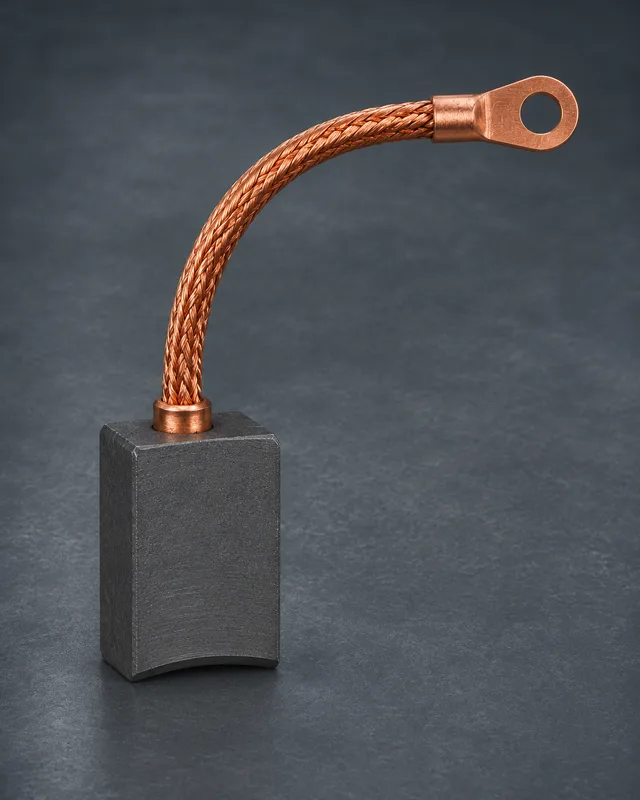
State block dimensions with their orientation, contact-face form and the top features interacting with the holder arrangement. Include lead length, lead attachment and terminal geometry where these are controlled. A catalog photograph can omit a hidden relief or make the terminal hole appear different from its actual specification. Use the approved drawing to define the item; use photographs to clarify orientation and identification.
Review the holder and contact system
Holder fit and condition belong in the application assessment. A brush can have the correct nominal dimensions yet be unsuitable for the approved holder or contact arrangement. Do not turn a purchasing checklist into a field adjustment procedure. Any changes to holder setup, contact preparation or operating conditions require the equipment's authorized maintenance instructions and competent review.
Require a declared material substitution process
If the existing grade is unavailable, ask for a written alternative proposal identifying the baseline grade, proposed grade, application data and supporting evidence. The equipment owner determines the required validation. Do not allow an undocumented supplier code change to become an unrecognized material change. Ensure packaging and release records retain the accepted grade identity, not just the block dimensions.
Application scenario
Illustrative scenario: a workshop finds a same-size brush with a different grade code and asks whether it can be stocked as equivalent. The buyer collects the motor and brush references and obtains the required technical review. Dimensional fit alone is not used to approve substitution or predict service performance.
Technical review checklist
| Review item | Required definition | Purpose |
|---|---|---|
| Equipment | Motor model and approved part | Identifies the application |
| Grade | Controlled material designation | Prevents generic-graphite substitution |
| Geometry | Oriented dimensions and contact face | Defines the correct block |
| Lead and terminal | Drawing and orientation | Defines the electrical connection |
Frequently asked questions
Can a same-size carbon brush be used in any motor?
No. Grade, equipment, contact geometry, holder and lead requirements must match the approved application.
Does the product illustration specify a motor-compatible part?
No. It shows a representative brush configuration; model-specific supply requires controlled technical information.
Technical references and scope
Public sources reviewed November 14, 2026 provide industry or standards-scope context. They do not transfer another manufacturer's approvals to Railwheel. Confirm the controlled standard edition, vehicle documents and acceptance criteria with the responsible authority. This article is procurement guidance, not installation, repair or service-release instructions.
Discuss your railway carbon brush requirement
Send the approved drawing and revision, application, quantity, required evidence and destination to Amy Sun at amy@railwheel.com. Scope and feasibility are confirmed through technical review before quotation.
 WhatsApp
 WeChat