
Coupler and Draft Gear Interfaces: Build a Supply Responsibility Matrix
Define responsibility for coupler, yoke, follower, draft gear and vehicle interfaces so an overhaul tender does not leave critical scope between suppliers.
· Vehicle Connections · Ma'anshan Railwheel Industrial Technology Co., Ltd.
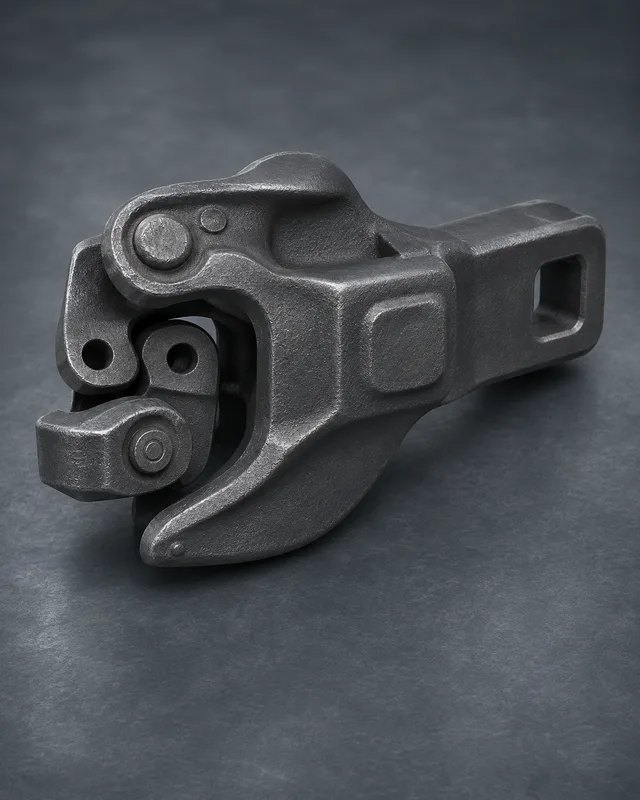
Start with the vehicle arrangement
End-of-car procurement often crosses several suppliers. The coupler may be quoted by one company, cushioning equipment by another and installation by a depot. The approved arrangement must connect these scopes. Identify the assembly drawing, revisions and responsible engineering authority first. Without that baseline, every supplier can meet its own quotation while the combined package still leaves a gap.
Assign every interface to an owner
For each drawing-defined interface, state who provides the input, who checks compatibility and who approves the result. Do not use a general supplier coordination clause as a substitute for these assignments. Identify which party controls the pocket envelope, yoke and follower arrangements, permitted movements and adjacent clearances. The matrix should reference documents, not merely department names.
Engineering principle: force-displacement behavior is not an envelope dimension
Two cushioning arrangements can occupy a similar space yet have different force-displacement behavior and different accepted application scopes. A geometrically interchangeable item is not necessarily a functionally approved item. The responsibility matrix should therefore assign both interface verification and performance-evidence review. It should also identify who controls changes affecting the vehicle arrangement. Otherwise, one supplier may accept dimensions while another assumes performance approval has already occurred, leaving the most important decision unowned. The matrix closes that gap only when its deliverables and approval owners are explicit.
Keep performance and geometry connected
A component can share an installation envelope with another without sharing its approved behavior. The tender should identify the functional acceptance basis and required qualification evidence for the chosen arrangement. Do not specify only the available space and invite an unreviewed performance substitution. If suppliers propose alternatives, require a written difference schedule and an engineering disposition before price normalization.
Include installation and commissioning boundaries
Clarify whether the contractor supplies loose parts, an assembled package or a defined installation service. Identify the owner of installation instructions, fixtures, inspection and final release. Some assemblies can involve stored energy and require product-specific authorized procedures; this article deliberately provides no dismantling or adjustment instructions. Commercial completeness must not be mistaken for authorization to perform maintenance.
Use the matrix during bid clarification
Ask each bidder to identify assumptions, exclusions and buyer-furnished inputs against the same schedule. Record unresolved items with an owner and due date. When the technical baseline changes, revise the affected quotations rather than leaving incompatible revisions in separate email chains. The final contract should incorporate the resolved matrix so receiving and installation teams know which deliverable closes each responsibility.
Application scenario
Illustrative scenario: a vehicle overhaul tender includes couplers and draft gear but omits responsibility for the follower interface. During clarification, the buyer assigns interface approval and updates both supplier scopes. This avoids treating an installation-stage mismatch as an unexpected spare-part problem.
Technical review checklist
| Review item | Required definition | Purpose |
|---|---|---|
| Coupler | Drawing and component scope | Named supply and approval owners |
| Cushioning arrangement | Functional and interface baseline | Required qualification review |
| Vehicle structure | Pocket and adjacent geometry | Vehicle-design responsibility |
| Installation | Procedure, records and release | Authorized maintenance responsibility |
Frequently asked questions
Does equal pocket size prove draft gear equivalence?
No. The approved functional requirements, interfaces and qualification basis also need review.
Is this article an installation instruction?
No. Installation and dismantling must follow the authorized, model-specific maintenance process.
Technical references and scope
Public sources reviewed November 14, 2026 provide industry or standards-scope context. They do not transfer another manufacturer's approvals to Railwheel. Confirm the controlled standard edition, vehicle documents and acceptance criteria with the responsible authority. This article is procurement guidance, not installation, repair or service-release instructions.
Discuss your railway coupler requirement
Send the approved drawing and revision, application, quantity, required evidence and destination to Amy Sun at amy@railwheel.com. Scope and feasibility are confirmed through technical review before quotation.
 WhatsApp
 WeChat