
Friction Wedges and Bolster Pockets: Why Mating Geometry Matters
Assess a freight bogie friction wedge with its bolster pocket, side-frame contact and approved spring arrangement instead of comparing outlines.
· Suspension · Ma'anshan Railwheel Industrial Technology Co., Ltd.
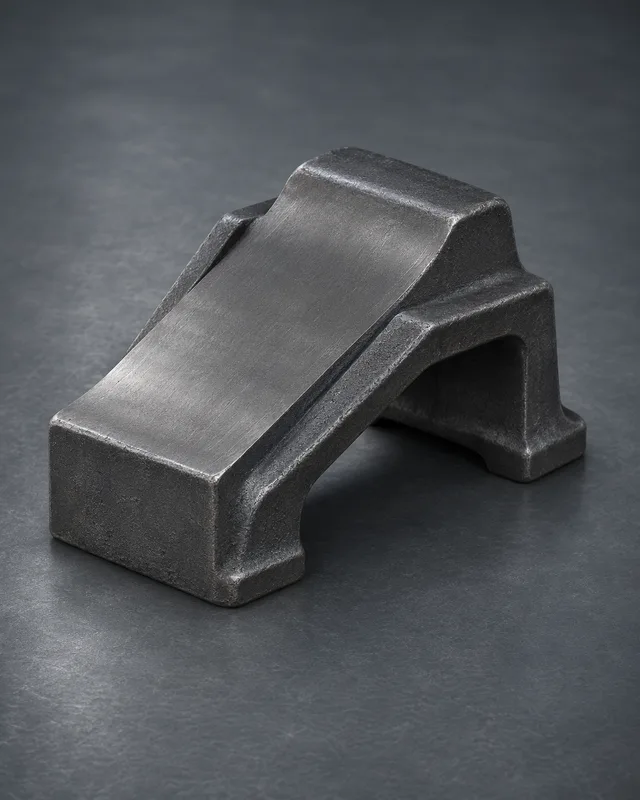
A wedge belongs to a suspension system
The friction wedge interacts with mating parts rather than functioning as an independent block. Its contact geometry and the surrounding suspension arrangement establish the intended behavior. Public manufacturer catalogs distinguish multiple wedge constructions and applications; that variety is a warning against universal interchangeability. A generic product illustration can explain the category, but the approved bogie definition must identify the actual replacement.
Map each working interface
Identify the inclined contact in the bolster pocket, the opposing friction surface, spring contact where applicable and locating features. Assign each interface its drawing reference. Ask whether the scope includes associated wear plates or other replaceable elements. The RFQ should let the supplier see both sides of a critical contact, not just a single wedge drawing detached from the assembly.
Engineering principle: damping is path-dependent
A friction-damped arrangement involves force and relative movement at defined contacts. The energy associated with one idealized motion cycle relates to the force-displacement path, not just a static wedge dimension. Surface pairing, normal loading and motion history can matter to the system behavior. It would therefore be misleading to assign one universal friction coefficient or damping value to all components sold as railway wedges. The product drawing controls the purchased geometry and material; the approved suspension design and its validation establish the relevant behavior. Both baselines are needed when considering a change.
Distinguish wear observations from acceptance values
A service photograph may reveal uneven contact or wear, but it cannot define a new wedge's required angle, surface finish or profile. Record observations separately from the manufacturing specification. Do not average dimensions measured from worn parts and call the result an approved design. If mating parts are damaged or changed, obtain the maintenance authority's disposition before ordering a component intended to work against them.
Review faced and split designs explicitly
A split wedge or a wedge with a specified facing is a configuration choice, not a cosmetic variation. Identify the construction, materials, attachment requirements and applicable assembly. Supplier alternatives should include a difference schedule and their proposed evidence. Do not transfer one manufacturer's interchangeability statement to another supplier's component; the statement's design and product scope matter.
Make the quotation acknowledge the complete baseline
Require drawing revision, bogie identity, material and contact-surface requirements in the technical offer. Separate unresolved interfaces from compliant items. A quotation can remain preliminary while information is missing, but it should not silently assume geometry. The final purchase order should point to the accepted baseline and disposition of any deviations, so inspection has a definite reference.
Application scenario
Illustrative scenario: a buyer replaces a wedge while retaining a bolster with an uncertain wear-plate revision. Comparing the wedge's width alone would miss the mating-interface question. The team retrieves the bolster and wear-part definitions, records their actual configuration and seeks an authorized compatibility decision before purchase.
Technical review checklist
| Review item | Required definition | Purpose |
|---|---|---|
| Inclined face | Pocket and wedge drawings | Match the contact definition |
| Friction interface | Approved mating surface | Check material and condition requirements |
| Spring interface | Assembly and position | Avoid the wrong suspension variant |
| Alternative design | Difference schedule | Require an explicit approval decision |
Frequently asked questions
Can a wedge fit but still be unsuitable?
Yes. Physical insertion does not establish the required contact, material or suspension behavior.
Does a manufacturer's interchangeability claim cover every supplier?
No. Read it within the manufacturer's stated design scope; another supplier must establish its own approved compatibility.
Technical references and scope
Public sources reviewed November 14, 2026 provide industry or standards-scope context. They do not transfer another manufacturer's approvals to Railwheel. Confirm the controlled standard edition, vehicle documents and acceptance criteria with the responsible authority. This article is procurement guidance, not installation, repair or service-release instructions.
Discuss your railway friction wedge requirement
Send the approved drawing and revision, application, quantity, required evidence and destination to Amy Sun at amy@railwheel.com. Scope and feasibility are confirmed through technical review before quotation.
 WhatsApp
 WeChat